
Is Your AI Actually
Safe to Run?
Your product's AI features, chatbots, copilots, RAG pipelines, autonomous agents introduce risks that a traditional pentest was never built to catch. The AI & LLM Security Audit tests your AI against the OWASP Top 10 for LLM Applications, the industry-standard reference for GenAI security risk, adapted to how you've actually implemented it.
Commonly used as supporting evidence for ISO/IEC 42001 and SOC 2 efforts. See exactly how it fits.



TESTED
TOP 10 EDITION
START TO REPORT
ENGINEER REVIEWED
AI Features Shipped,
Never Stress-Tested
Most teams that added LLMs, copilots, or agents to their product have never tested what those features can actually be tricked into doing. A working demo isn't the same as a system that holds up against a crafted prompt, a poisoned document, or an agent given more tool access than it needs.
The OWASP Top 10
for LLM Applications
Your AI agents are part of your attack surface. We test against all 10 risk categories in the 2025 OWASP Top 10 for LLM Applications, adapted to how you've actually implemented AI — chatbots, copilots, retrieval-augmented systems, and autonomous agents with tool or function-calling access.
Every finding is mapped back to its OWASP risk category and rated by severity — so you get a focused, credible technical audit, not a vague "AI safety review."
Does This Support
ISO/IEC 42001 or SOC 2?
Auditors for both frameworks ask a version of the same question: do you test your AI/LLM systems for security risk, and can you show evidence? This audit is built to be that evidence. It's a technical security assessment, not a governance or compliance certification. Here's exactly where it fits and what's still needed.
Supports Your AI Management System
ISO/IEC 42001 is mostly a governance standard — policies, leadership, risk processes, documentation. This audit supplies the technical verification evidence a subset of Annex A actually calls for:
- A.6 AI System Life Cycle — verification, validation & monitoring evidence
- A.5 AI System Impact Assessment — real risk findings to assess against
- A.9 Use of AI Systems — evidence for responsible-use processes
Supports Your Security Evidence
SOC 2 evaluates controls across your whole environment, operating effectively over a period of time. This audit is accepted as evidence for the criteria that touch AI/LLM security specifically.
- CC7 (Common Criteria) — vulnerability identification & monitoring evidence
- Confidentiality criterion — data leakage findings, if selected
Supports, doesn't replace. If you're pursuing ISO/IEC 42001 or SOC 2, this report is the evidence that answers the AI/LLM security-testing question every auditor asks. Pair it with a governance-focused gap assessment if you also need the rest of the management system — policies, roles, risk processes, documentation — built out.
Six Phases, 5-7 Days
A focused, technical engagement — scoped to the AI/LLM surface only, so it moves faster than a full application audit.
Kick-Off & Scoping
Type in your website URL. No account needed, no sign-up forms — just your domain.
01
Recon & Threat Modelling
Map how your AI is actually built — models used, tools it can call, data it can access.
02Prompt-Level Testing
Manual and AI-assisted testing against Prompt Injection, Sensitive Information Disclosure, System Prompt Leakage, and Misinformation.
03Agent & Pipeline Testing
Testing against Supply Chain, Data & Model Poisoning, Improper Output Handling, Excessive Agency, Vector/Embedding Weaknesses, and Unbounded Consumption.
04Findings Consolidation
Every finding mapped to its OWASP LLM Top 10 category and rated by severity.
05Report & Presentation
Present findings to stakeholders, answer questions, close out.
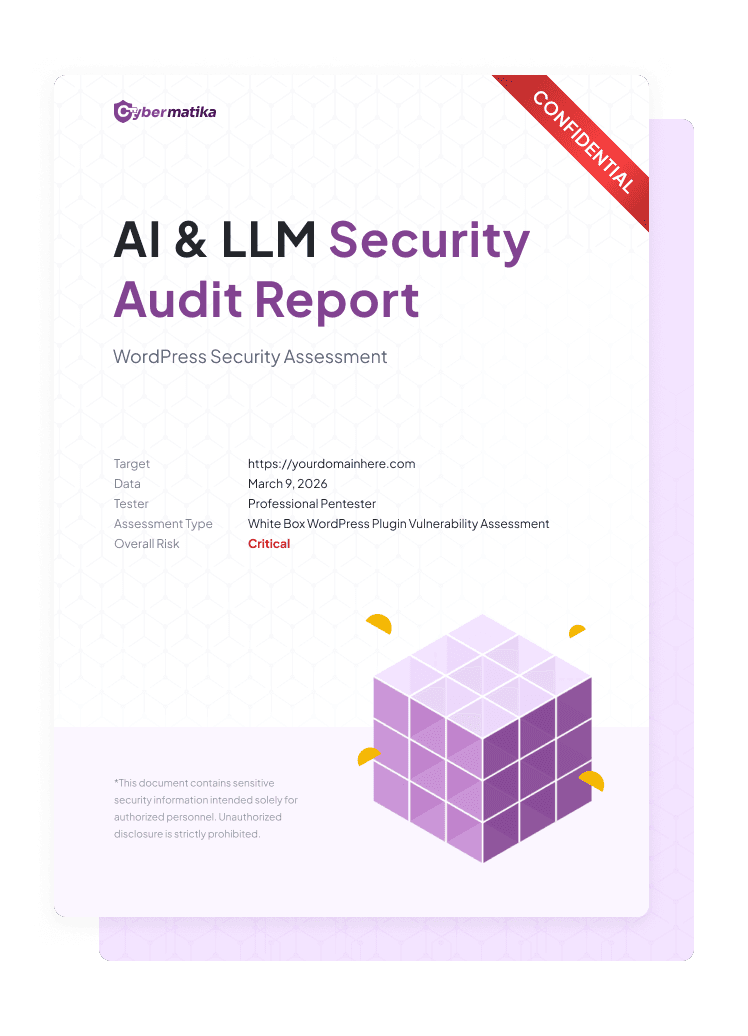
06The AI & LLM Security Audit Report
A single, structured report mapping every finding to the OWASP Top 10 for LLM Applications — built for both technical teams and non-technical stakeholders.
What's Inside the Report
Every finding is tied to a specific OWASP risk category, so leadership sees a clear, prioritised picture of AI risk — not a vague narrative.
- ✓Executive summary of AI/LLM risk posture
- ✓Findings mapped to each of the 10 OWASP LLM risk categories
- ✓Proof-of-concept for exploitable findings, where safe to demonstrate
- ✓AI Risk Register (Critical / High / Medium / Low)
- ✓Prioritised Roadmap: Quick Wins / Short-Term / Strategic
- ✓Stakeholder presentation with live Q&A
Show the World Your AI Is Actually Tested
Every completed audit includes the Cybermatika Certification — a verifiable badge for your website, pitch deck, or security questionnaire.

What the Badge Represents
- Tested against all 10 OWASP LLM Top 10 (2025) risk categories
- Comes with a public verification page prospects can check
- Valid 12 months; revoked if a critical finding goes unresolved

Display the Cybermatika Certified badge on your website or product with a link back to our Cybermatika Certification page, and you'll get 10% off the Audit price.
A technical security audit, not a compliance certification. This engagement tests your AI implementation against the OWASP Top 10 for LLM Applications (2025) — it's a technical security assessment, not a governance or compliance certification such as ISO/IEC 42001 or SOC 2. It's commonly used as supporting evidence alongside those frameworks, or as a standalone check before you rely on an AI feature in production. See exactly how it maps to ISO/IEC 42001 and SOC 2.
Built for Teams Running Real AI Features
An independent, evidence-based read on what your AI can actually be tricked into doing — before someone else finds out for you.

Built With AI Agents or LLMs
Your product relies on LLMs, copilots, or autonomous agents, and no one has stress-tested what they can actually do.

Pre-Launch AI Features
You're about to ship an AI feature and want independent confirmation it can't be trivially jailbroken or abused.

Already Live, Handling Real Data
Your AI is in production and touches real user or business data — you need to know exactly what it might leak.

Investor or Customer Due Diligence
You need a credible, independent AI security audit to satisfy an investor, an enterprise customer, or a vendor questionnaire.
Simple, Fixed-Fee Pricing
No hourly guesswork — a flat fee for a one-off audit, or a discounted rate the more regularly you audit.
One-Off Audit
A full audit of your AI/LLM implementation against the OWASP Top 10, delivered as a single engagement.
Fixed fee, no ongoing commitment
6-Monthly Plan
An audit every six months — a steady check-in for teams whose AI features change at a slower, more considered pace.
2 audits per year, AUD 4,500 total
3-Monthly Plan
An audit every quarter — for teams shipping new models, prompts, or agent features regularly.
4 audits per year, AUD 7,500 total
Already displaying your Cybermatika Certified badge? Ask about your 10% loyalty discount on any plan above.
Pair It With Security & Code Review
This audit is scoped to the AI/LLM surface only. If you also need penetration testing or a codebase review, these cover that ground.

Rapid Pentest
A standalone penetration test against your live application, delivered in 5-7 days.

AI Codebase Security Scan
A multi-agent AI review of your full codebase, cross-checked and signed off by a senior engineer, delivered as one prioritised report.

Technical Code Review
An independent review of your codebase, tech stack, and infrastructure, with a prioritised risk register.
Common Questions
No. The AI & LLM Security Audit is a technical security assessment, not a governance or compliance certification such as ISO/IEC 42001 or SOC 2. It is commonly used as supporting evidence alongside those frameworks, or as a standalone check before you rely on an AI feature in production.
Any autonomous or semi-autonomous system that calls an LLM and can take actions — tool/function-calling agents, copilots, retrieval-augmented generation (RAG) pipelines, chatbots, and custom LLM integrations. If your product calls a model and acts on its output, it counts.
We can test against a live implementation (black-box) or with documentation and read access (grey-box). Source code access deepens the review of agent logic and output handling, but is not required for the standard engagement.
No. Testing is designed to be non-disruptive. We coordinate with your team to test in a controlled manner, and any potentially impactful testing is done in a staging or sandbox environment when available.
Yes. Pre-launch is the ideal time to test — you can fix findings before they reach production users. The audit gives you independent confirmation that your AI feature cannot be trivially jailbroken or abused before you ship it.
A one-off audit typically runs 1–2 weeks from kick-off to report presentation. The exact timeline depends on the size of your AI surface and how quickly we can access the systems in scope.
A flat, fixed fee — no hourly billing. The one-off audit is a single engagement, while the 6-monthly and 3-monthly plans deliver audits on a fixed cadence at a discounted per-audit rate. The price you see is the price you pay.
The certification is valid for 12 months from the audit date. It is revoked if a critical finding goes unresolved. After 12 months, a re-audit is required to maintain the certification.
Yes. Display the Cybermatika Certified badge on your website or product with a link back to our Cybermatika Certification page, and you will receive 10% off the audit price on any plan.